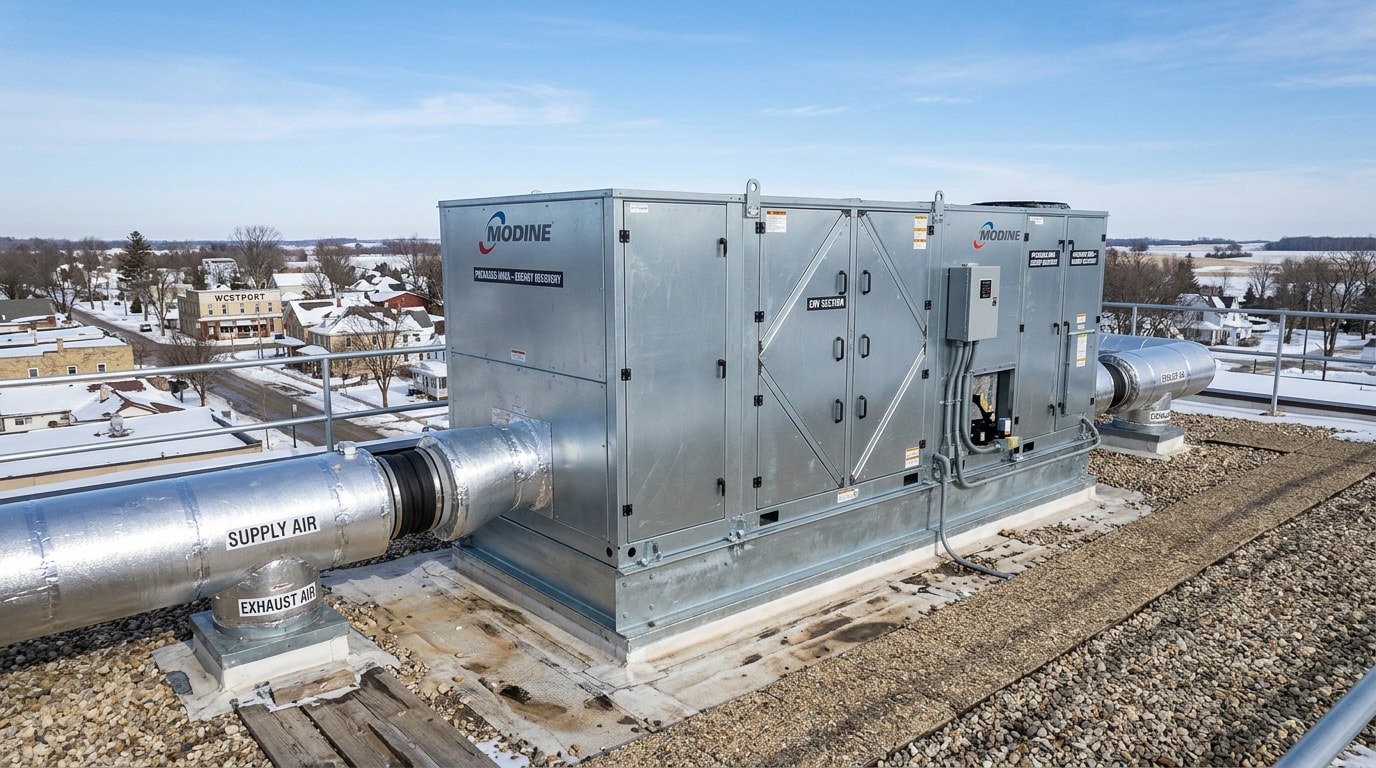
DOAS HVAC in Cadott, WI solves a ventilation problem that a furnace or rooftop swap never will. A dedicated outdoor air system treats fresh air as its own job, sized on code airflow instead of space load. In a climate that swings from humid 85°F July afternoons to subzero January mornings, that outdoor air is usually the hardest load your building carries.
What Is a DOAS Unit?
A DOAS conditions 100% outdoor air. It filters that air, cools and dries it in summer, heats it in winter, then delivers it to the occupied space. A separate system handles room heating and cooling.
That split is called decoupled ventilation, and it is the entire point of the equipment. A dedicated outdoor air system runs two parallel systems: one dedicated to outdoor ventilation air that handles both the latent and sensible loads of conditioning it, and a parallel system for the mostly sensible loads from indoor sources and the building envelope.
By conditioning outdoor air and recirculated air independently, the DOAS removes the latent load to control humidity while the main HVAC unit removes the sensible load to hold temperature.
Because the two jobs are separated, each one gets sized and controlled for what it actually does. If you are scoping a project, our HVAC contractor services page covers how that scoping works.
Quick Specs: DOAS Rooftop Unit
| Spec | Typical range |
|---|---|
| Outdoor air handled | 100% |
| Tonnage | ~2 to 60+ tons |
| Airflow | ~500 to 15,000 CFM |
| Supply air dew point | ~45°F to 55°F |
| Energy recovery | Wheel or plate core, roughly 50% to 80% effectiveness |
| Parallel system | Heat pumps, VRF, fan coils, or zone RTUs |
These are typical equipment ranges, not a quote. The main HVAC system fed by a DOAS can be almost any type, but it is usually smaller zonal equipment such as water source heat pumps, VRF systems, or fan coil units. Your actual selection comes out of a load calculation on your building.
How Does a DOAS Unit Work?
Follow the air and it makes sense.
- Outdoor air enters through a dedicated intake and passes through filtration.
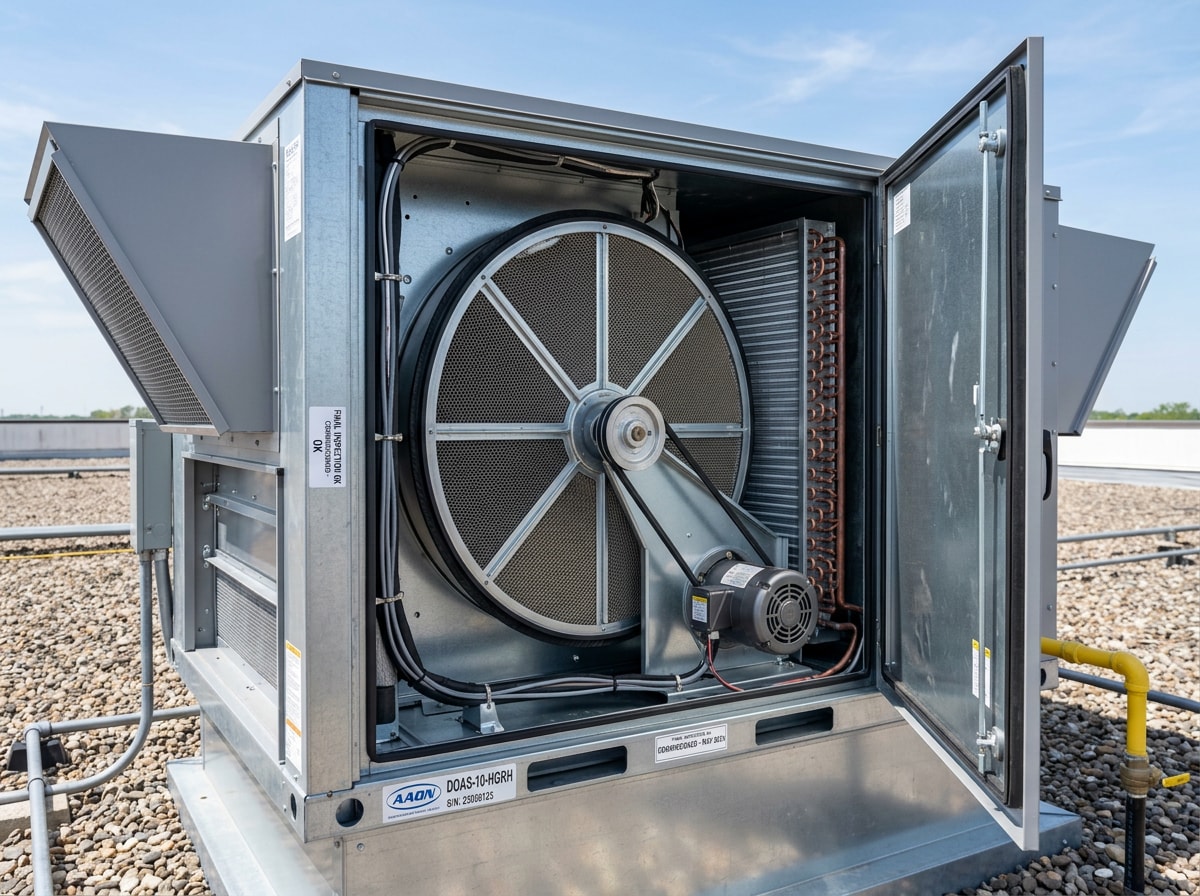
- An energy recovery wheel or plate core pre-treats it using the building's exhaust stream.
- A cooling coil pulls the air below dew point, wringing out moisture.
- In winter, a heating coil tempers the air instead, often after a preheat stage.
- A supply fan pushes the treated air to zones or to zone terminal equipment.
A DOAS unit typically cools and dehumidifies in summer and heats, sometimes humidifies, in winter, and a basic unit holds a preheat coil, a cooling coil, a reheat coil, and a humidifier.
Here is the detail most owners never hear: a DOAS is judged on dew point, not on supply temperature. You commission a DOAS on dew point rather than supply temperature alone, because a mixed-air unit is judged by whether the room hits setpoint, while a DOAS is judged by whether the air it delivers is dry enough to absorb the building's moisture all year, including mild wet days when the sensible system is barely running.
That matters in the Chippewa Valley every May and September, when it is 62°F and raining and the rooftop units are idle. Those are the hours when buildings get clammy, and the hours a correctly controlled DOAS earns its keep.
The second local wrinkle is sizing. A mixed-air rooftop unit blends a small slug of outdoor air into a much larger stream of return air, so extremes get diluted. A DOAS takes the extreme undiluted, every hour it runs. The coil has to be right at both ends of the calendar.
DOAS vs. RTU vs. ERV vs. AHU: The Cheat Sheet
| DOAS | RTU | ERV | AHU | |
|---|---|---|---|---|
| Outdoor air handled | 100% | ~10% to 30% | 100%, both streams | 0% to 100%, as designed |
| Primary job | Ventilation and dehumidification | Space heating and cooling | Energy recovery between airstreams | Move and condition air |
| Recirculates room air | No | Yes | No | Usually yes |
| Space heating and cooling | No | Yes | No | Yes, with coils |
| Typical location | Rooftop or mechanical room | Rooftop | Rooftop, attic, or mech room | Mechanical room |
| Relative first cost | High | Moderate | Low to moderate | Moderate to high |
Choose a DOAS when ventilation drives the load and humidity matters.
Choose an RTU when a simple single zone box is enough.
Choose an ERV when you need recovery but space conditioning already works.
Choose an AHU when you need a custom coil, fan, and filter arrangement inside the building.
A local note on DOAS vs. RTU: small Cadott-area buildings with roof structural limits or tight budgets often land on an ERV, because it is the lightest and cheapest path to code airflow. DOAS wins once occupancy climbs and humidity becomes a liability rather than a nuisance.
What a DOAS Costs in the Cadott Area
Nobody can hand you a price without a load calculation, but you can budget intelligently. These are planning ranges we use when scoping commercial work in Chippewa and Clark counties, not quotes.
| Project scope | Planning range | Notes |
|---|---|---|
| Packaged DX DOAS, small (under 2,000 CFM) | $25,000 to $60,000 installed | Curb, crane, controls integration included |
| Mid-size DOAS with energy recovery (2,000 to 6,000 CFM) | $60,000 to $150,000 installed | Roof framing often drives cost |
| Retrofit distribution ductwork | Varies widely | Frequently the largest single line item |
| Annual service and filters | Budget two to four visits | Wheel seals, belts, drain pans, filters |
Three cost drivers surprise owners most often:
- Roof structure. A DOAS plus recovery section is heavy, and reinforcing an older Cadott-area roof deck can rival the equipment cost.
- Distribution. Running conditioned outdoor air to each space is new ductwork, not a reuse of existing trunk lines.
- Controls. The DOAS has to sequence with the zone equipment, and that integration is engineering labor, not a thermostat.
The offset is real, though. Once terminal units stop conditioning outdoor air, their capacity requirement drops, sometimes enough to change the equipment class on every zone. That is why DOAS pencils out best in new construction and major renovation, and rarely in a low-occupancy office retrofit.
Ready to put numbers on your building? Get a free estimate and we will start with a ventilation load review, not an equipment pitch.
Wisconsin Code and Efficiency Rules You Should Know
Most national DOAS articles cite ASHRAE 62.1 and stop. In Wisconsin, that is not the document your plan reviewer opens.
Commercial ventilation here is governed by chapter SPS 364, which adopts and amends the International Mechanical Code. Before Wisconsin adopted the IMC, almost all ventilation and exhaust requirements sat in a table in SPS 364, and the IMC now splits ventilation and exhaust into two separate chapters.
Where an occupancy does not match the state table, IMC chapter 5 determines whether exhaust is required and how much. If you want the state's own plain-language take, the Wisconsin DSPS ventilation FAQ is worth ten minutes before you design anything.
On the equipment side, DOAS now has its own federal efficiency class. The Code of Federal Regulations defines a direct expansion dedicated outdoor air system as a unitary DOAS capable of dehumidifying air to a 55°F dew point under AHRI 920-2020 Standard Rating Condition A, with a moisture removal capacity under 324 lb/h.
The federal levels mirror ASHRAE 90.1-2019, at 4.0 ISMRE for air-cooled units without energy recovery and 5.2 ISMRE with recovery. You can verify the current scope on the U.S. Department of Energy's DX-DOAS page.
Practical translation: ISMRE, not SEER or EER, is the number to compare when two bids list different DOAS models. A unit with recovery clears a higher bar by rule, which is one more reason recovery is standard on nearly every Wisconsin selection we specify.
Benefits, Honestly Weighed
Air quality. Steady outdoor airflow dilutes CO2, VOCs, and particles. The EPA frames indoor air quality control as three strategies: manage pollutant sources, dilute and remove pollutants through ventilation, and filter the air. More on that from the EPA's guidance for offices and other large buildings.
Humidity control. Drying outdoor air at the source keeps moisture out of wall cavities, duct exteriors, and ceiling plenums. That matters in clinics, grocery stores with open cases, and fitness spaces.
Smaller zone equipment. Terminal units sized for sensible load only are often one class smaller.
Predictable compliance. The DOAS delivers design airflow whether or not the space calls for cooling.
Now the costs. First cost is higher because you are buying two systems. Structural work, roof penetrations, and controls integration add to it. Maintenance is heavier too: recovery wheels need belt, seal, and surface inspection, and filters are larger and changed more often than on a comparable RTU. Budget for a contractor who has actually commissioned DOAS controls, and keep it on a documented HVAC system maintenance schedule from day one.
What We See in the Field Around Cadott
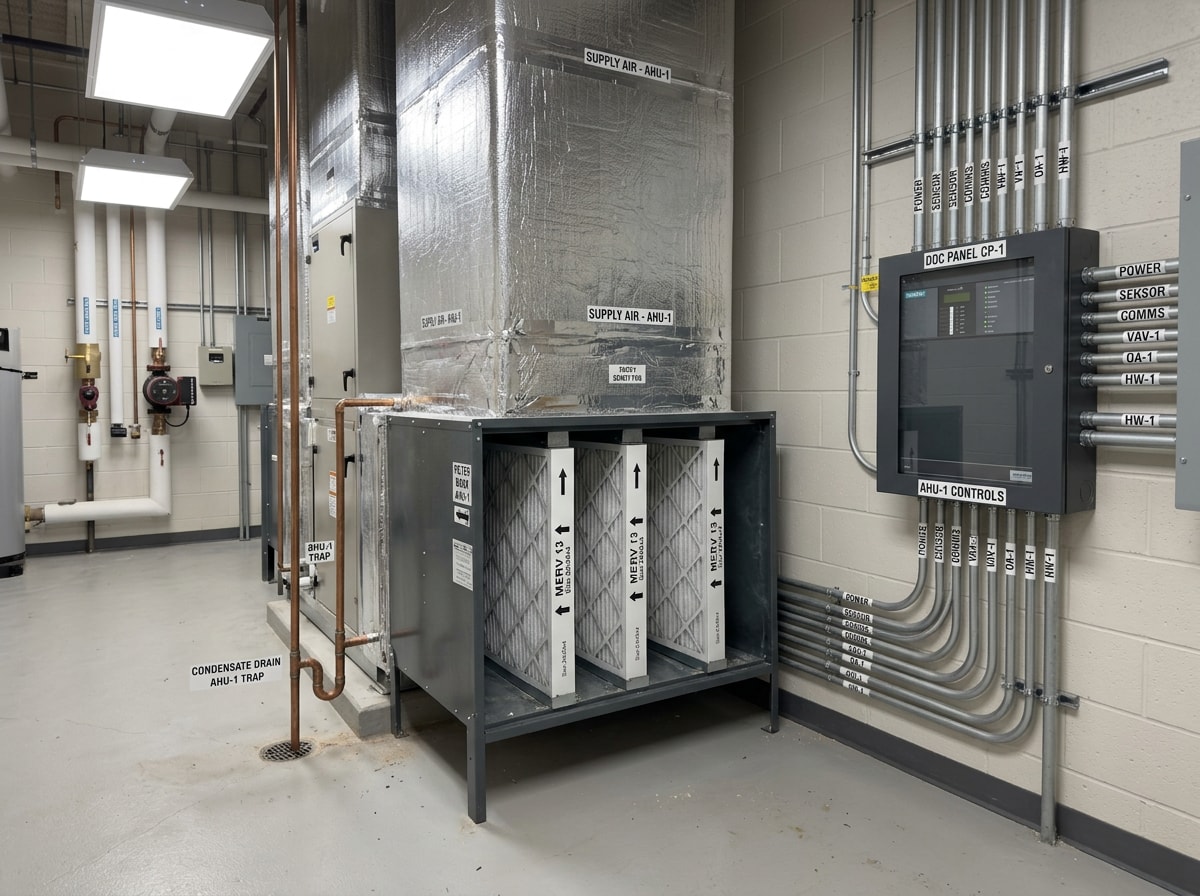
On one Chippewa County commercial job, the complaint was not temperature, it was condensation on interior glass and a musty smell in shoulder season. The rooftop units were holding 72°F fine. They just were not running long enough on mild humid days to dehumidify anything.
That building did not need more tonnage. It needed ventilation air delivered at a controlled dew point, independent of the thermostat. That is the pattern we see repeatedly in high-occupancy spaces here, and it is why we start every assessment with ventilation rates and occupancy schedules before touching equipment selection.
For smaller zone-level cooling paired with a ventilation upgrade, our write-up on mini split air conditioner installers in Cadott, WI covers the parallel sensible system side. You can also browse recent project examples or confirm coverage on our Cadott, WI service area and Chippewa County pages.
FAQ
What is a dedicated outdoor air system?
A dedicated outdoor air system is HVAC equipment that filters, conditions, and dehumidifies 100% outdoor ventilation air, then delivers it to occupied spaces. A second system handles space heating and cooling.
What is the difference between a DOAS and a standard rooftop unit?
A rooftop unit conditions mostly recirculated air with a small amount of outdoor air blended in. A DOAS handles ventilation and dehumidification only. The choice comes down to how large your ventilation load is relative to your space load.
Does a DOAS save energy compared with standard ventilation?
Usually, with conditions. Savings come from energy recovery plus decoupling ventilation from space conditioning. Actual reduction depends on recovery effectiveness, required ventilation rate, climate, and annual run hours, so results vary building to building.
Does a DOAS need energy recovery?
In practice, yes, on most Wisconsin commercial projects. ASHRAE 90.1 commonly triggers an energy recovery requirement at 5,000 cfm supply with 70 percent or more outdoor air, at roughly 50 percent minimum enthalpy effectiveness. Federal efficiency levels are also easier to clear with recovery installed.
What supply temperature should a DOAS deliver?
Dew point matters more than dry bulb. A common DOAS supply dew point target is 50 to 55 degrees, though the design engineer and project specification set the actual number.
Cold supply is usually more efficient than neutral supply, because reheating dehumidified air back to room temperature discards sensible cooling you already paid for.
What building types are best suited for a DOAS?
High-occupancy and humidity-critical spaces: schools and classrooms, medical and dental offices, labs, fitness centers, grocery and retail, commercial kitchens, and manufacturing. Around Cadott, that usually means schools, clinics, and food processing facilities.
Does a DOAS replace my furnace or air conditioner?
No. It replaces the ventilation function only. You still need a parallel system for space heating and cooling, which is where HVAC system installation planning comes in.
How often does a DOAS need service?
Plan on two to four visits a year, more if your filters load fast. Wheel seals, drive belts, drain pans, coils, and dampers all need eyes on them, and winter preheat and frost control sequences should be verified before cold weather.
Next Step for Your Building
If ventilation drives your load, start with a ventilation and humidity assessment rather than an equipment quote. We will tell you honestly when a DOAS is overkill and an ERV or a right-sized RTU will do the job.
Visit the Del Mar Air LLC homepage to see our full commercial scope, or contact our team to schedule a load assessment in Cadott and the surrounding Chippewa Valley.
This guide reflects the commercial service and design-assist experience of the Del Mar Air LLC team, working on schools, clinics, and light industrial buildings across Chippewa and Clark counties.