HVAC labor rates in Cadott, WI run roughly $70 to $155 per billable hour in 2026, with most scheduled residential work landing between $95 and $125. The spread is wide because technician tier, job timing, and rural drive time each move the number. Here is how to tell which end of that range your quote belongs at, using wage data you can verify yourself.
HVAC Labor Rates in Cadott, WI: The 2026 Numbers
Short version before the detail:
- Typical billable labor rate, scheduled daytime work: $95 to $125 per hour
- Full range across tiers: about $70 to $155 per hour
- Service call / diagnostic fee: $75 to $250
- Wisconsin HVAC technician median wage: about $29.67 per hour
- Wisconsin vs. national median wage: roughly 1 percent above
Cadott is rural Chippewa County, so real quotes here usually sit in the lower-to-middle half of the full band. The top of the range reflects commercial work, master-tier specialists, and Milwaukee or Madison metro overhead.
A straightforward residential furnace repair in Chippewa County should not be billed at a metro commercial rate. If you are comparing bids, anchor to the middle and work outward.
Scope, tier, and timing explain almost every variance you will see across HVAC services.
What Wisconsin HVAC Technicians Actually Earn
Labor rates start with wages, and wages are public data.
In the BLS Occupational Employment and Wage Statistics survey for May 2025, Wisconsin heating, air conditioning, and refrigeration mechanics and installers posted a median annual wage of $61,710, with a 10th percentile of $45,930 and a 90th percentile of $98,070 across 6,630 workers . Converted to hourly at 2,080 hours, that is about $22.08, $29.67, and $47.15.
Here is the part most cost pages miss. Wisconsin's HVAC median sits only about 1.1 percent above the national median of $61,010, the closest to parity of the major Wisconsin trades . Wisconsin is not a cheap labor market and it is not a premium one either.
| Wage benchmark (Wisconsin, BLS May 2025) | Annual | Hourly |
|---|---|---|
| 10th percentile | $45,930 | ~$22.08 |
| Median | $61,710 | ~$29.67 |
| 90th percentile | $98,070 | ~$47.15 |
Full state and national wage tables are published by the U.S. Bureau of Labor Statistics occupational profile for this trade.
Why the Billable Rate Is Roughly Three Times the Wage
This is the question that actually settles arguments about pricing. Here is the arithmetic on a journeyman-level technician in Chippewa County, step by step.
- Base wage: about $29.67 per hour at the Wisconsin median.
- Payroll burden: payroll taxes and workers' comp, a high class code for mechanical trades, push the loaded cost to roughly $41 to $43.
- Benefits and training: health coverage, paid time off, and ongoing EPA Section 608 and manufacturer training land near $45.
- Utilization: a tech paid for 40 hours does not bill 40 hours. In rural Chippewa County, with 20 to 40 minute drives between calls, 26 to 28 billable hours is a realistic week. That alone lifts the loaded cost per billable hour to roughly $62 to $68.
- Overhead: truck payment, fuel, truck stock, general liability, dispatch software, and the office add $18 to $25 per billable hour.
- Margin: a modest profit on top produces the $95 to $125 band.
| Tier | Approx. hourly wage | Modeled billable rate |
|---|---|---|
| Apprentice / helper | ~$22 | $70 to $85 |
| Journeyman technician | ~$29.67 | $95 to $125 |
| Master / specialist | ~$47 | $135 to $155 |
Those billable figures are our modeled estimates built from the BLS wage percentiles plus typical burden, utilization, and overhead, not published rate tables. Treat them as a sanity check, not a quote.
The takeaway for Cadott homeowners: rural drive time compresses utilization harder than it does in a metro. That is the single biggest reason a licensed technician's rate out here is not lower than in the city.
Service Call and Diagnostic Fees
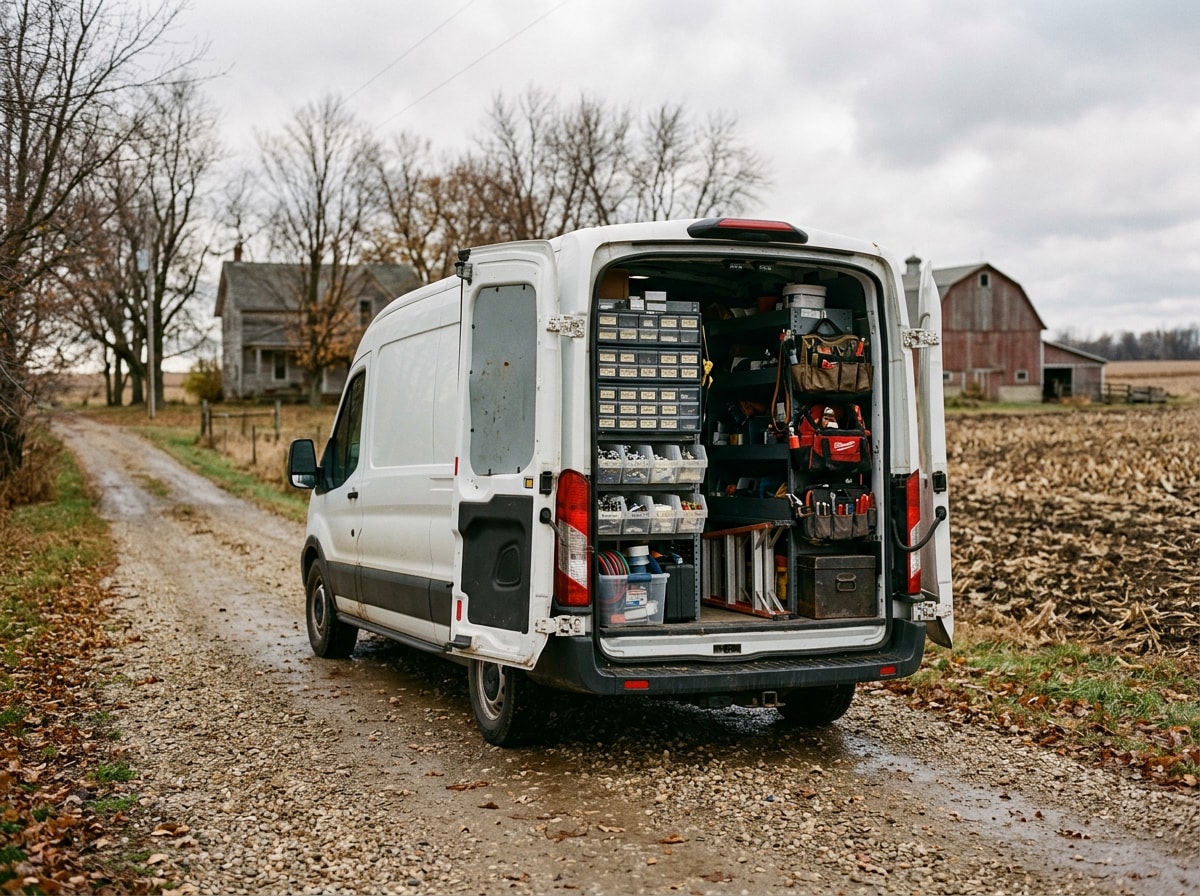
Nearly every company charges a service call fee, also called a diagnostic fee, trip charge, or dispatch fee, separate from the hourly rate. In 2026 that fee typically runs $75 to $250, with most residential calls between $75 and $200.
The fee usually breaks into tiers:
- Basic trip charge: lowest tier, covers travel and arrival
- Standard diagnostic: systematic troubleshooting plus a written finding
- Emergency diagnostic: after-hours or same-day dispatch
- Second-opinion diagnostic: sometimes discounted, sometimes not
Many companies treat it as a minimum service charge and credit it against the repair once you approve the work. Others keep it regardless. Both are legitimate, but they produce very different totals on a $200 job.
Ask one question when you book: is the diagnostic fee credited toward the repair if I approve the work? Get the answer in the appointment confirmation, not just over the phone.
Want a written number before anyone turns a wrench? Get a free estimate and we will put the diagnostic policy in writing.
Emergency and After-Hours Rates
Timing moves the number more than almost anything else.
| Timing | Typical hourly range | Service call fee |
|---|---|---|
| Standard weekday | $75 to $150 | $75 to $150 |
| Evening after 5 PM | $110 to $200 | $125 to $200 |
| Weekend | $125 to $225 | $150 to $250 |
| Holiday | $150 to $275 | $175 to $300 |
| Immediate emergency dispatch | $150 to $300 | $200 to $350 |
Practice varies more than those tiers suggest. Some contractors double the regular rate after hours. Others simply add $40 to $80 per hour. Ask before you agree to a 9 PM dispatch.
The realistic scenario here is a no-heat call during a January cold snap, which is when emergency furnace service pricing stops being theoretical.
Minimum-hour charges also bite harder in rural areas. If the tech drives 25 minutes each direction, a two-hour minimum is standard, and a 40 minute repair still bills two hours.
Flat Rate vs. Hourly Pricing
Two billing models show up on Cadott-area quotes, and they are not comparable at a glance. Hourly pricing shows you the rate. Flat-rate pricing hides it inside a single repair price.
How flat rate pricing works
The company quotes a fixed price for a specific repair before work begins, drawn from a standardized rate book that accounts for average labor time, parts, and overhead. You approve the number up front, and it does not change if the job runs long.
How to back-solve the hourly rate
- Subtract the parts cost from the flat price.
- Divide what is left by the hours the job realistically takes.
- Compare that figure to the $70 to $155 band above.
A $420 capacitor-and-contactor job with $90 in parts over 1.5 hours works out to about $220 per hour, which is high for scheduled daytime work. The same job at $260 works out to roughly $113 per hour, right in range.
One honest note: a flat-rate price that looks steep on a 30 minute repair usually reflects a service minimum or an expensive part, not gouging. Time and materials billing often lands in the same place once the minimum applies.
How Labor, Materials, Permits, and Equipment Split the Invoice
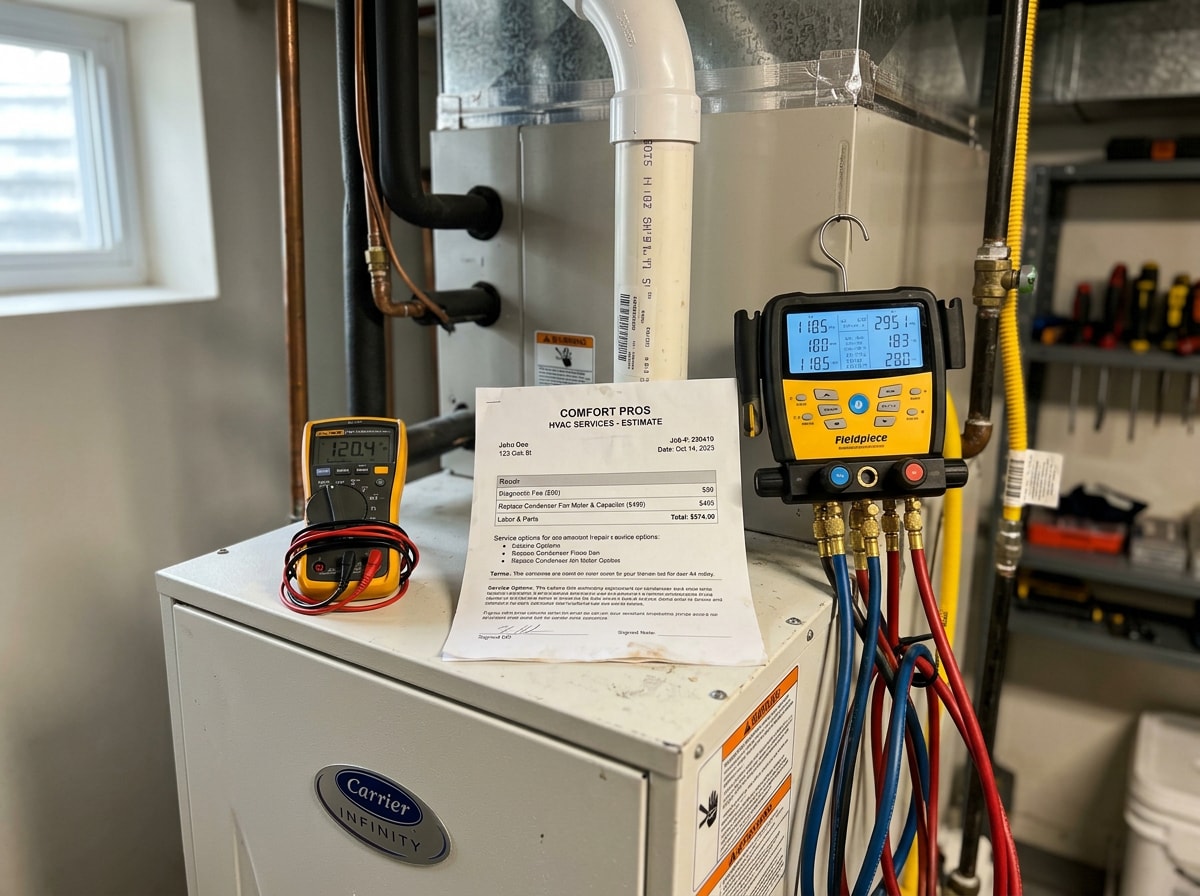
Labor usually accounts for 40 to 60 percent of a repair or small-install invoice. Knowing the split helps you read a quote critically.
| Line item | Typical share or range |
|---|---|
| Labor | 40% to 60% of invoice |
| Materials (refrigerant, fittings, wire, duct) | $50 to $600 |
| Equipment (furnace, condenser, coil, heat pump) | $1,200 to $8,000+ |
| Permits and inspection | $50 to $400 |
| Delivery and old-unit disposal | $50 to $250 |
Permits deserve a word. A straight repair generally does not trigger one. A replacement or new installation typically does, and that line is a real municipal cost passed through, not padding.
Design labor on a replacement is the same story. ACCA Manual J is the ANSI-recognized standard for residential equipment sizing loads, and a load calculation performed to that procedure is required by national building codes and most state and local jurisdictions . Read the sizing standard at the Air Conditioning Contractors of America Manual J page.
That engineering time is billable work. Skipping it is how a homeowner ends up with an oversized furnace that short cycles for fifteen years. Our furnace replacement and HVAC system installation quotes include it as a line, not a freebie.
Typical Repair Prices in and Around Cadott
Most HVAC repairs land between $150 and $450 all in, labor plus parts, before any after-hours surcharge.
| Job | Typical total cost |
|---|---|
| Furnace diagnostic and tune-up | $80 to $200 |
| Furnace igniter or flame sensor replacement | $150 to $400 |
| Furnace blower motor replacement | $400 to $900 |
| Furnace control board replacement | $400 to $950 |
| Heat pump defrost control repair | $300 to $700 |
| Heat pump reversing valve replacement | $600 to $1,500 |
| Thermostat replacement | $140 to $350 |
| AC capacitor or contactor replacement | $150 to $450 |
| Refrigerant leak detection and recharge | $250 to $1,000 |
| Condensate drain clearing | $100 to $250 |
Heating work dominates the list for a reason. A Chippewa County furnace logs far more runtime than the air conditioner does.
For job-specific pricing, see furnace repair or air conditioning repair, and confirm your address sits inside the Cadott service area. Rates in neighboring towns track closely, as the breakdown in our Stanley HVAC hourly rate guide shows.
Licensing, Code, and Why Cheap Rates Get Expensive
Mechanical work on a Wisconsin one or two family home falls under the Uniform Dwelling Code chapters in Wis. Admin. Code SPS 320 to 325, and contractors need current DSPS credentials to do it.
Verification takes about two minutes:
- Look up the business or credential holder through the Wisconsin DSPS credential and license search.
- Confirm the credential status is active.
- Ask for a certificate of insurance alongside the written quote.
- Ask whether the technician holds EPA Section 608 certification for refrigerant work.
An unusually low hourly rate from an uncredentialed installer tends to cost more later. Manufacturer warranties commonly require installation by a licensed contractor, uninspected work can stall a sale, and a failed inspection means paying twice.
A Five Minute Quote Check
Run any Cadott-area quote through this before you sign:
- Is the hourly rate or flat price stated in writing, with the diagnostic fee policy named?
- Does the back-solved hourly rate land between $70 and $155?
- Is there a minimum-hour charge, and how many hours?
- Are parts listed separately with part numbers?
- For a replacement, is a Manual J load calculation included?
- Is the DSPS credential active and the insurance certificate current?
Six yes answers means the price is probably fair, even if it is not the lowest bid you received.
FAQ
How much does an HVAC contractor charge per hour in Wisconsin?
Expect roughly $70 to $155 per billable hour in 2026, with scheduled residential work usually at $95 to $125. That band is modeled from a Wisconsin median technician wage of $61,710 a year in the BLS May 2025 survey , plus payroll burden, utilization, and overhead.
What is the difference between journeyman and master-level billing?
A journeyman-level technician typically bills $95 to $125 per hour, while master and specialist techs bill $135 to $155. Paying the higher tier makes sense for refrigerant diagnostics, commercial equipment, and warranty work that requires a specific credential.
How much should an HVAC service call fee be?
Most service call or diagnostic fees run $75 to $200 for scheduled daytime visits, and up to $350 for emergency dispatch. Always ask whether the fee is credited toward the repair.
Why is HVAC labor so expensive compared to the technician's wage?
Because a tech paid for 40 hours only bills 26 to 28 of them in rural territory. Payroll taxes, workers' comp, benefits, truck costs, parts stock, insurance, and dispatch overhead all load onto those billable hours.
Is flat rate or hourly pricing better for a homeowner?
Flat rate protects you if the job runs long and removes the clock-watching. Hourly can be cheaper on quick repairs, but minimum-hour charges often erase the difference.
Do HVAC companies charge for estimates?
Replacement and installation estimates are commonly free, because no diagnosis is required. Repair diagnostics almost always carry a fee, since the technician is doing billable troubleshooting.
Are after-hours and weekend rates really double?
Sometimes, but not always. Some contractors double the rate, others add a flat $40 to $80 per hour. Ask for the specific after-hours number before you approve a late-night dispatch.
How long does a typical HVAC repair take in Chippewa County?
Most common repairs take 45 minutes to 2 hours on site. Add 20 to 40 minutes of drive time each way, which is why two-hour minimums are standard in rural service areas.
Does a maintenance plan lower the hourly rate?
Usually yes. Most plans include a discount on labor and priority scheduling, which matters most during a cold snap. See HVAC system maintenance for what a plan covers.
Get a Written Number for Your System
Delmar Air LLC serves Cadott and the surrounding Chippewa County communities with flat-rate repair pricing and written estimates. We built the utilization math above from our own dispatch logs, where drive time between rural calls routinely runs 25 minutes each way.
See examples of completed work on our projects page, browse services from the Delmar Air homepage, or get a free estimate and we will quote the job before the work starts.
Reviewed by the Delmar Air LLC service team, EPA Section 608 certified technicians working in Chippewa and Clark counties. Questions about a quote you received? Send it over through our contact page and we will tell you plainly whether it looks fair.