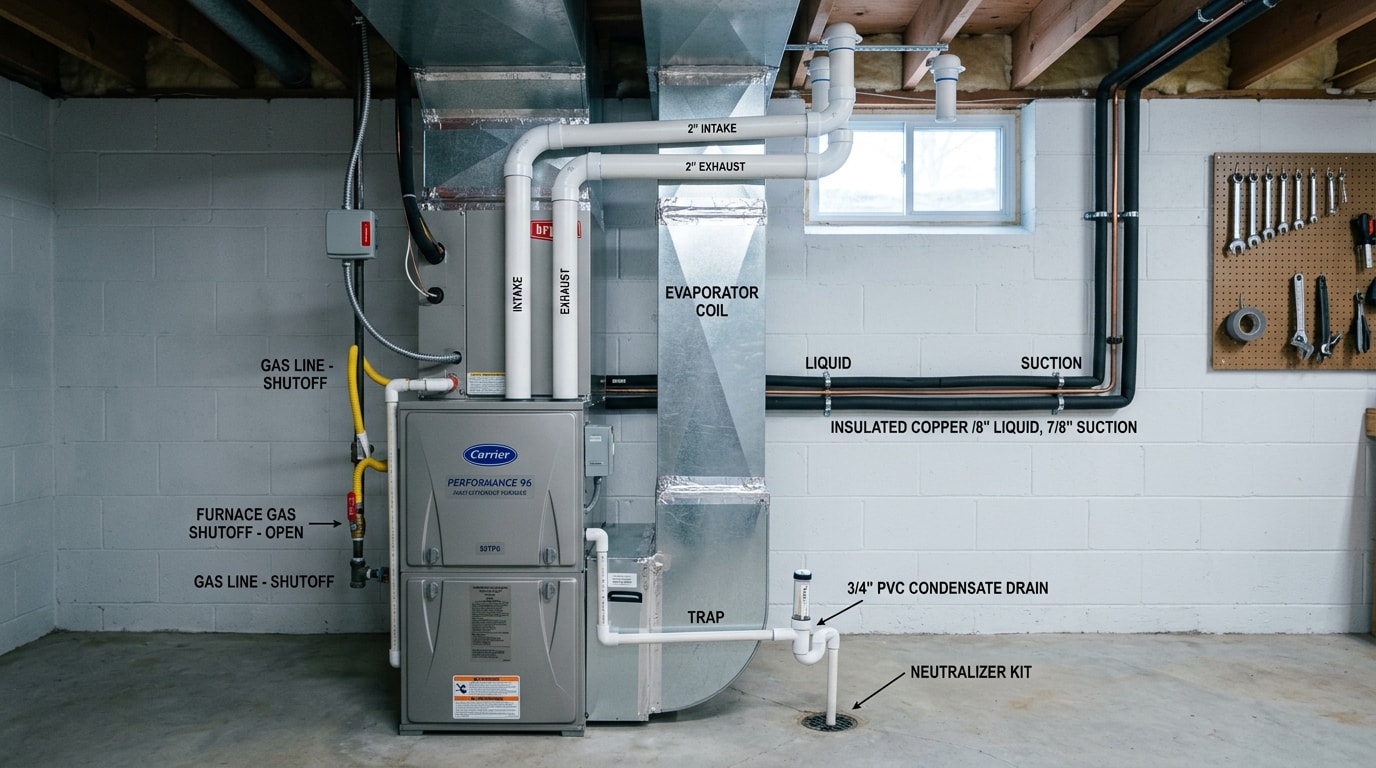
If you are searching for a mini split AC installer near me in Stanley, WI, you want three answers fast: what it costs, whether it heats in January, and who actually drives out here. This page gives 2026 installed ranges for the Chippewa County area, the low-temperature performance numbers that decide whether ductless works as real heat, and the exact commissioning steps a cheap install skips. Start with the pricing, because that is where most projects stall.
What Mini Split Installation Costs in Stanley, WI (2026)
There is no single ductless price, and any installed number quoted without someone standing in your house is a guess.
Most Stanley-area projects land in three bands:
| Tier | 2026 installed range | Typical fit |
|---|---|---|
| Basic single zone | $4,000 to $6,500 | Cooling-first jobs: sunroom, bedroom, home office |
| Premium cold-climate single zone | $5,500 to $9,500 | Heat plus cool in a garage shop or addition |
| Multi-zone, 2 to 4 heads | $9,500 to $17,500 | Upstairs plus main-floor coverage |
Whole-home systems with five or more heads commonly run $18,000 to $30,000 or above.
Those are planning estimates reconciled from recent Wisconsin project data. They are not a quote.
What Moves the Quote Up or Down
- Zone count. Every indoor head adds equipment, its own line set, and labor hours.
- Line set length and routing. Long runs cost more, and concealed line-hide across siding adds material and time versus a short direct penetration.
- Electrical work. No dedicated circuit at the panel means adding one, and occasionally a service upgrade.
- Head style. Wall-mount is the baseline. Floor-mount consoles and ceiling cassettes cost more to buy and to hang.
- Equipment tier. Cold-climate and high-SEER2 models carry a premium.
- Permit and inspection. A legitimate line item, not padding.
Labor is the other half of the number. If you want to sanity-check a bid against local rates, our breakdown of the HVAC hourly rate in Stanley) shows what shop time actually costs here.
Screen for Incentives Before You Set a Budget
Utility programs and the federal tax credit can move the net number meaningfully. Certification matters for eligibility: ENERGY STAR certified mini splits are independently certified to save energy and use up to 60% less energy than standard home electric radiators , and ENERGY STAR also maintains a separate cold climate designation worth asking about on any Wisconsin quote. Check the current list on the ENERGY STAR ductless heating and cooling page, then ask your installer which rebate forms they file for you.
Ready for real numbers on your house? Get a free estimate and we will size it before we price it.
Do Mini Splits Actually Heat Through a Wisconsin Winter?
Yes, a true cold-climate unit produces usable heat well below zero and will carry most of a Chippewa County heating season. The honest caveat is the coldest stretch, when capacity falls right as your demand peaks.
Performance follows outdoor temperature in bands:
- Above 25°F: the heat pump runs near peak efficiency, commonly around a COP of 3.0 or better, roughly three units of heat per unit of electricity.
- 5°F to 25°F: efficiency slides gradually, but output stays well ahead of electric resistance heat.
- Below 5°F: quality cold-climate units keep producing. Current models publish retained heating capacity down to -13°F in their submittal tables.
Stanley's winter design temperature sits near -15°F to -18°F depending on the data set your installer uses. That number, not a generic "Wisconsin" assumption, should drive equipment selection.
So plan on backup heat. Most homeowners here keep the existing furnace or boiler for the worst weeks of January and February and let the ductless system handle the other 80 percent of the season.
The failure mode to avoid is a cheap import unit built for cooling, with a rated heating range that stops near 5°F. Ask for the HSPF2 rating and the published low-temperature capacity table before you sign.
One detail we have learned the hard way on sub-zero mornings in converted garages with uninsulated slabs: the unit holds temperature, but it runs flat out to do it. Size and insulate accordingly, and do not expect a specific heating bill reduction. That depends on your envelope and the fuel you are backing up.
Two Snow-Country Details Most Quotes Leave Out
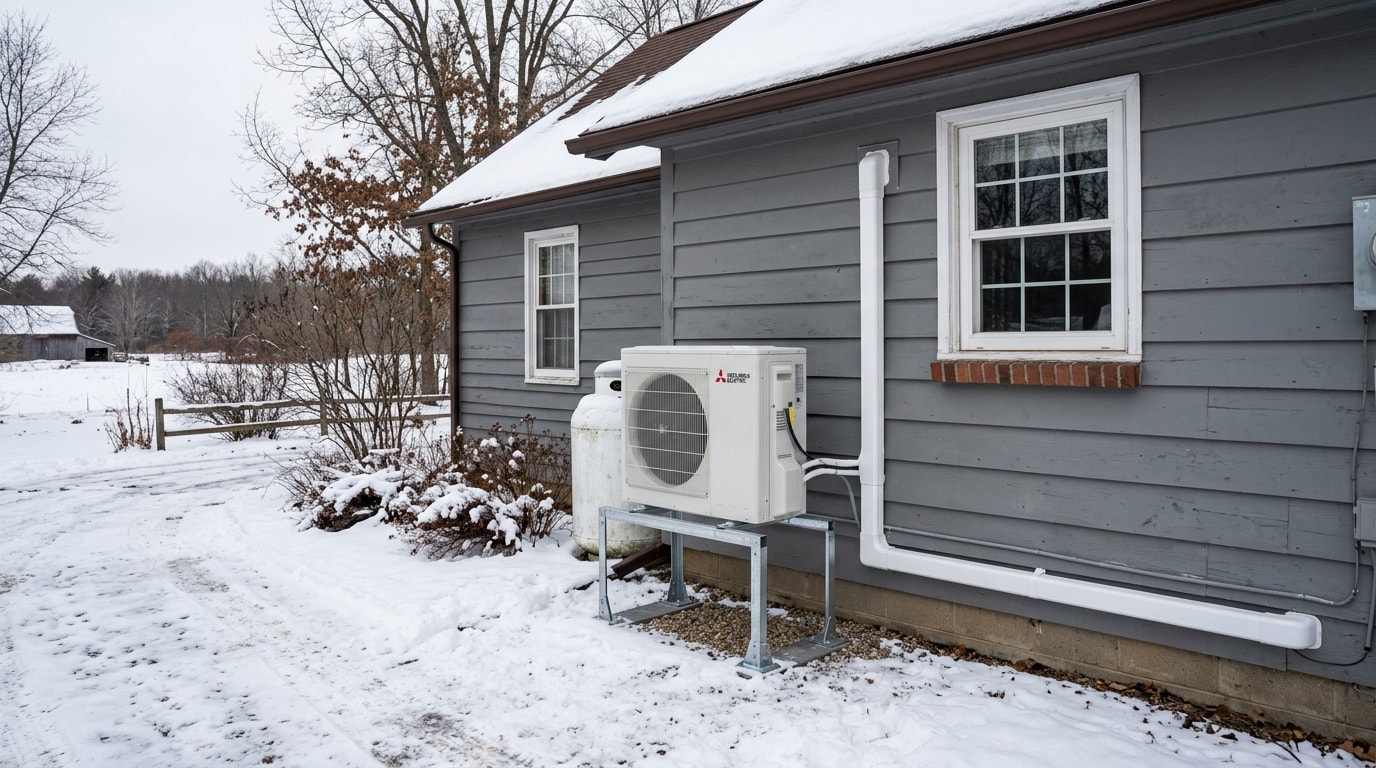
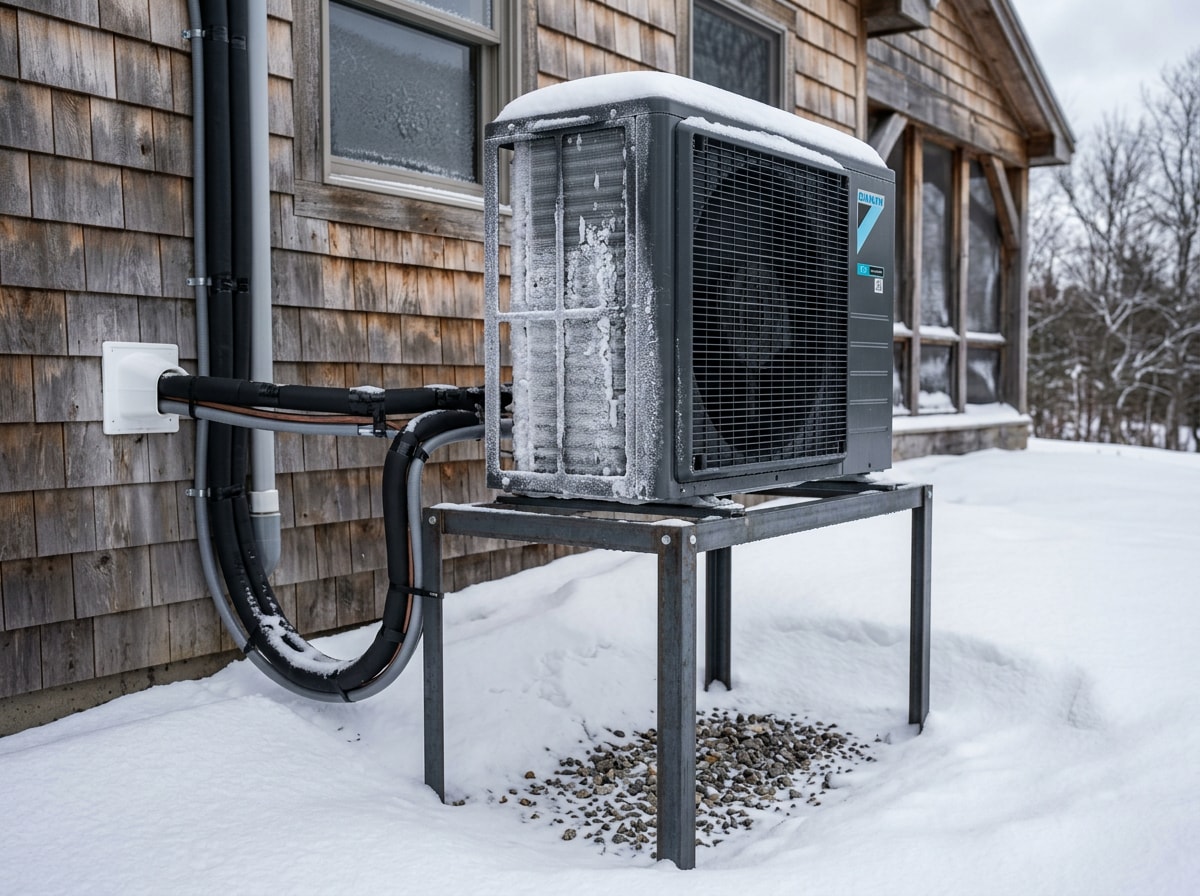
- Stand height. The outdoor unit belongs on a stand that lifts the base well clear of drift and roof runoff, typically 18 to 24 inches above grade in this snowbelt. A unit set on a slab at grade will ice its base pan by February.
- Defrost drainage. Heat pumps shed meltwater during defrost cycles. Without a clear drip path, that water refreezes under the coil and chokes airflow. A base pan heater and gravel bed solve it cheaply at install, not later.
Where Ductless Makes Sense in Stanley Homes
Most calls start with a complaint, not a product request. A hot upstairs bedroom. A garage shop the furnace was never meant to reach. A window unit that is loud, ugly, and still losing.
Almost all of it traces to one cause: no ductwork where you need conditioned air.
Four local project types drive this search:
- A garage conversion turned into a shop or office
- An attic build-out
- A four-season room off the back of the house
- Older farmhouses with no duct path to a second floor
Extending trunk ductwork into any of those is usually the wrong answer. You pay for demolition, lost ceiling height, and framing changes, and in a century-old house there may be no straight run available at any price. The U.S. Department of Energy notes that ductless minisplits are an excellent option for retrofitting homes with non-ducted heating and are ideal for room additions where extending ductwork is not feasible , which matches what we see on ductless retrofit projects around Stanley.
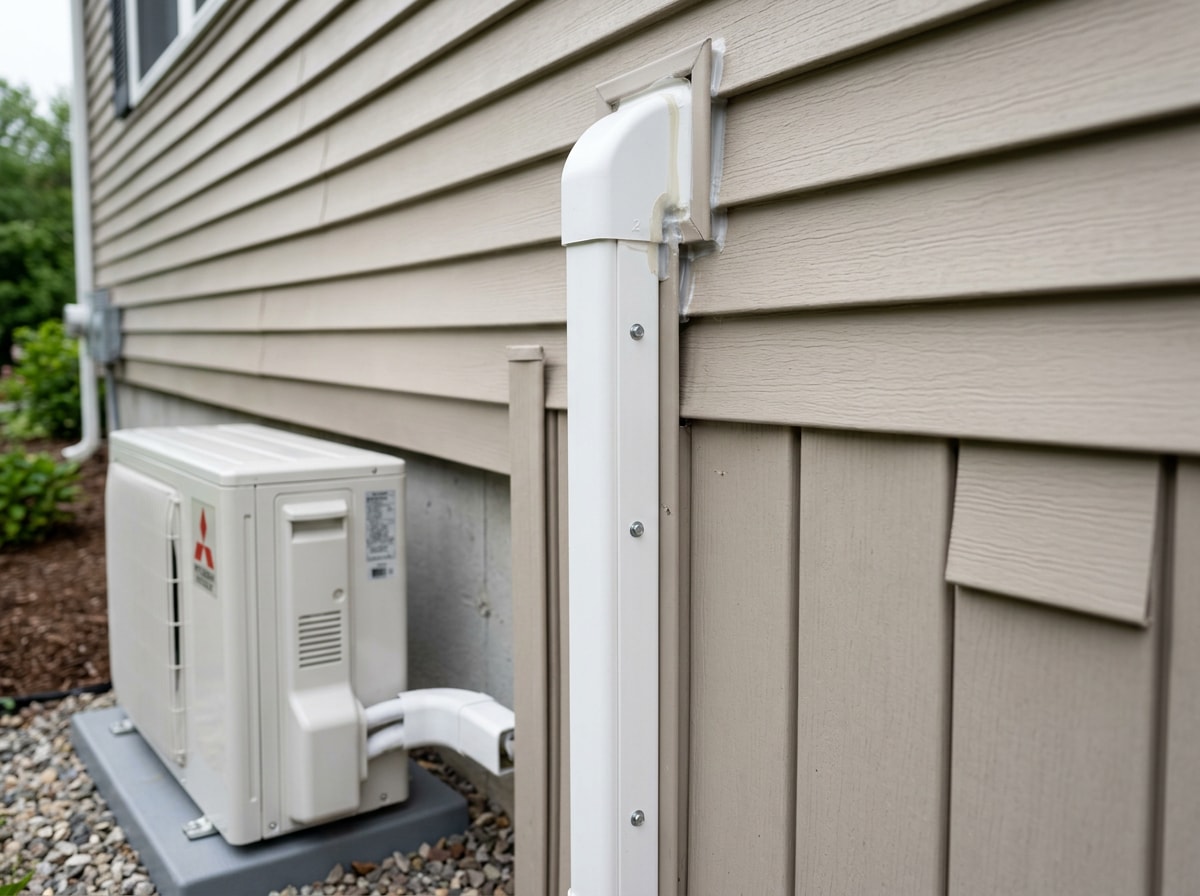
The line set connecting the indoor head to the outdoor unit passes through one cored hole in an exterior wall, typically about three inches across. An addition can be fully conditioned in a day without a single soffit.
Quiet and Zoned, in That Order
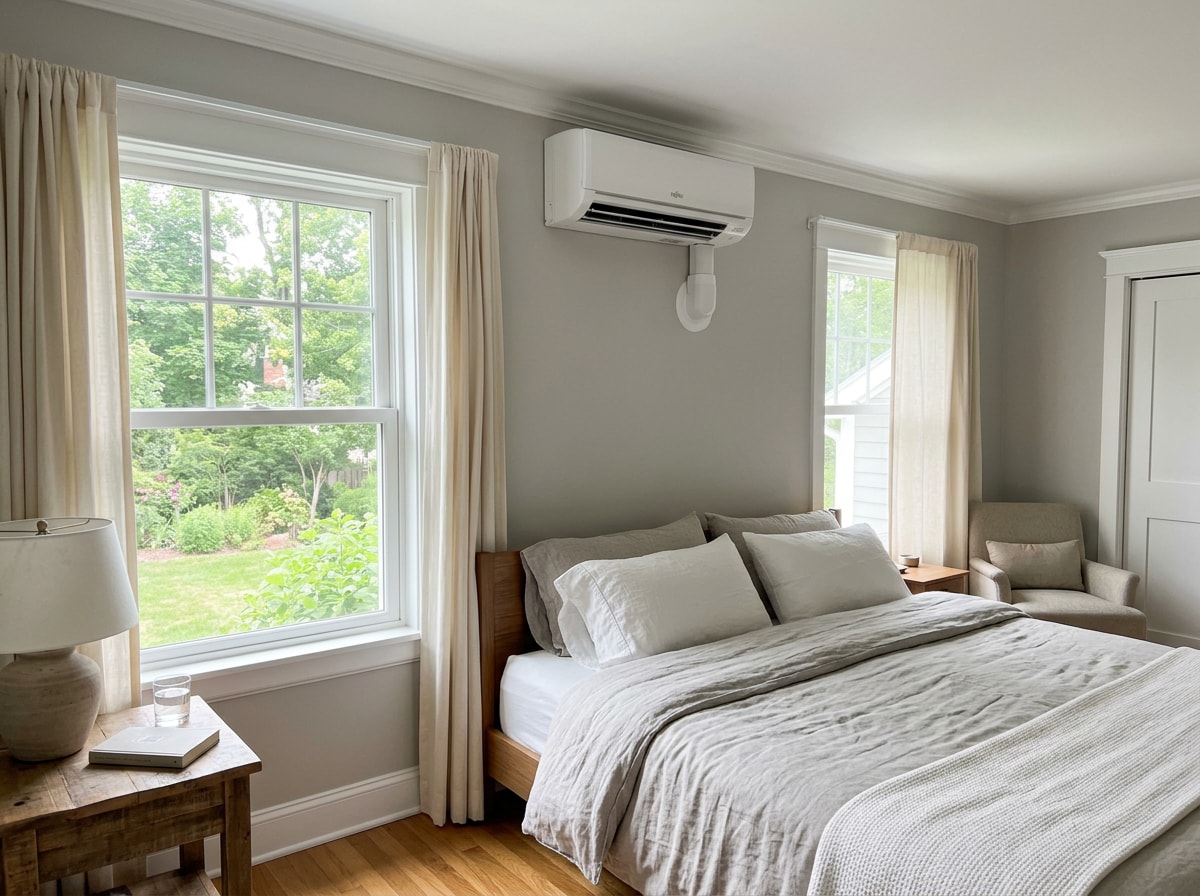
The compressor, the loud part of any air conditioner, sits outside. Indoors, all that runs is a variable-speed fan behind a plastic cowling.
That is why customers mention noise first after install, usually without expecting to. Compare it to a window unit cycling two feet from your pillow.
The operating-cost argument is zoning. Instead of cooling 2,000 square feet to fix one 300-square-foot sunroom, you condition only the occupied room and set its temperature independently. The inverter compressor modulates rather than slamming between full blast and off, so it holds setpoint at partial load, where a system spends most of its life.
Treat any flat percentage savings claim with suspicion. Yours depends on what you are replacing.
What Happens on Install Day
It starts with a sizing visit, not a sales sheet.
A proper load calculation uses square footage, window exposure, insulation, and ceiling height to set BTU capacity. The ANSI-recognized standard is ACCA Manual J, and a load calculation performed to that procedure is required by national building codes and most state and local jurisdictions . You can read the scope of Manual J residential load calculation directly from ACCA.
Oversizing causes short cycling and poor humidity removal. Undersizing leaves you cold in February. An installer who quotes tonnage off square footage alone is the red flag you are looking for when comparing bids.
Then placement: where the head throws air best, and where the condenser sits clear of drifts and roof runoff.
Install day itself covers the mounting bracket, the cored wall penetration, the line set and condensate route, and setting the outdoor unit. A single-zone job is usually one day. Multi-zone runs two to three.
Commissioning is the step cheap installs skip:
- Pressure test and nitrogen purge while brazing, so no scale forms inside the lines
- A deep vacuum pulled and held, with a micron gauge reading confirmed before refrigerant is released
- Temperature split measured across the indoor coil
- Compressor amp draw checked against the data plate
- Warranty registered on the spot
Refrigerant handling requires federal certification. EPA regulations under Section 608 of the Clean Air Act require technicians who maintain, service, repair, or dispose of refrigerant-containing equipment to pass an EPA-approved test . That is the practical reason a DIY kit and a professional install are not the same product.
Our HVAC system installation page lists what is included, and we also handle straight AC installation when ductless is not the right call. Once the system is in, annual A/C system maintenance keeps the warranty intact and the coils clean.
How to Vet a Mini Split Installer Near You
Ask these five questions before you choose:
- Will you perform a Manual J load calculation, and can I see it?
- What is the published heating capacity of this model at -13°F?
- What micron level do you pull and hold before charging?
- Who pulls the mechanical and electrical permits?
- Who registers the manufacturer warranty, and when?
A contractor who answers all five without hedging is worth more than the cheapest bid on your counter.
Serving Stanley and the Surrounding Area
We install ductless systems in Stanley and across Chippewa County, including Cadott, Boyd, Thorp, Cornell, Holcombe, Jim Falls, and Chippewa Falls.
What you get in writing: a Wisconsin HVAC contractor credential, EPA Section 608 certified technicians, pulled permits, and registered warranties. Estimates in the Stanley area are typically scheduled within a few business days.
Browse the full range of HVAC contractor services, see what else we do at Delmar Air LLC, or request your free estimate.
FAQ
How much does it cost to install a mini split in Stanley, WI?
Budget $4,000 to $6,500 for a basic single zone, $5,500 to $9,500 for a cold-climate single zone, and $9,500 to $17,500 for a two to four head multi-zone system. Electrical work, line set length, and head style move the number within those bands.
Can a mini split heat a house through a Wisconsin winter?
A cold-climate model can heat through most of the season on its own, including sub-zero days. Keep an existing furnace or boiler as backup for the coldest stretches, and verify the published capacity at -13°F before buying.
How long does a mini split installation take?
A single-zone install is typically one working day. Multi-zone systems usually take two to three days, longer if the electrical panel needs work first.
Does a mini split need its own circuit?
Yes. The outdoor unit requires a dedicated circuit and a disconnect sized to the manufacturer's spec. If your panel has no space, add the cost of a subpanel or service upgrade to your budget.
Do you need a permit to install a mini split?
Usually yes, for both the mechanical and electrical work, though requirements vary by jurisdiction. Confirm with the City of Stanley or the county building department. A reputable installer pulls the permit and schedules the inspection as part of the job.
Can I install a mini split myself?
Technically yes, with a pre-charged DIY kit, but that is where most self-installs fail. Cutting, flaring, or charging a refrigerant line requires EPA certification, the circuit must meet code, and most manufacturer warranties require professional installation and registration to stay valid.
Can a mini split replace central air?
Yes. A multi-zone system can cover a whole house, and that is common where no duct paths exist. Watch the break-even point: a five or six head system can cost more than ducts plus conventional central air in a home already set up for ductwork.
How long do mini splits last?
Expect roughly 15 to 20 years with annual service, somewhat less on coastal or heavy-dust sites. Coil cleaning and filter care are the two habits that drive the high end of that range.
Do mini splits need maintenance?
Yes. Wash the indoor filters monthly during heavy use, and have the indoor blower wheel, coil, and condensate path cleaned professionally each year. Neglected blower wheels are the single most common cause of weak airflow and musty odor complaints.
Is a ductless mini split worth it?
Use a rule instead of a yes or no. It is clearly worth it when there is no ductwork, when one problem room needs its own zone, or when you want heating and cooling from one unit. It is less compelling in a home with sound ducts and a healthy furnace.
Reviewed by the Delmar Air LLC install team: Wisconsin HVAC contractor credential, EPA Section 608 certified technicians, serving Stanley and Chippewa County. Questions about your own house? Contact us.