Searching commercial heating and air conditioning near me in Cadott, WI usually means one thing: a rooftop unit is down, the building is emptying out, and every hour costs money. This guide covers what a commercial call should cost, what Wisconsin code requires before equipment gets swapped, and the five things to verify before you hand over a purchase order.
Emergency Commercial HVAC Service in Cadott: What to Expect
Restaurants, clinics, and production floors cannot wait until Monday.
We dispatch emergency air conditioning service and emergency furnace service around the clock across Cadott and the surrounding Chippewa Valley.
What honest emergency response looks like:
- A live person on the phone, not a voicemail queue.
- A stated arrival window before the truck rolls, not "sometime today."
- Building stabilization first: temporary heat, a bypassed economizer, a locked-out stage, whatever keeps the doors open.
- Straight talk on parts. Common belts, igniters, contactors, and capacitors ride on the truck. A compressor or a specific control board for a 12-year-old rooftop unit often means next-day sourcing, and you should be told that on the first visit.
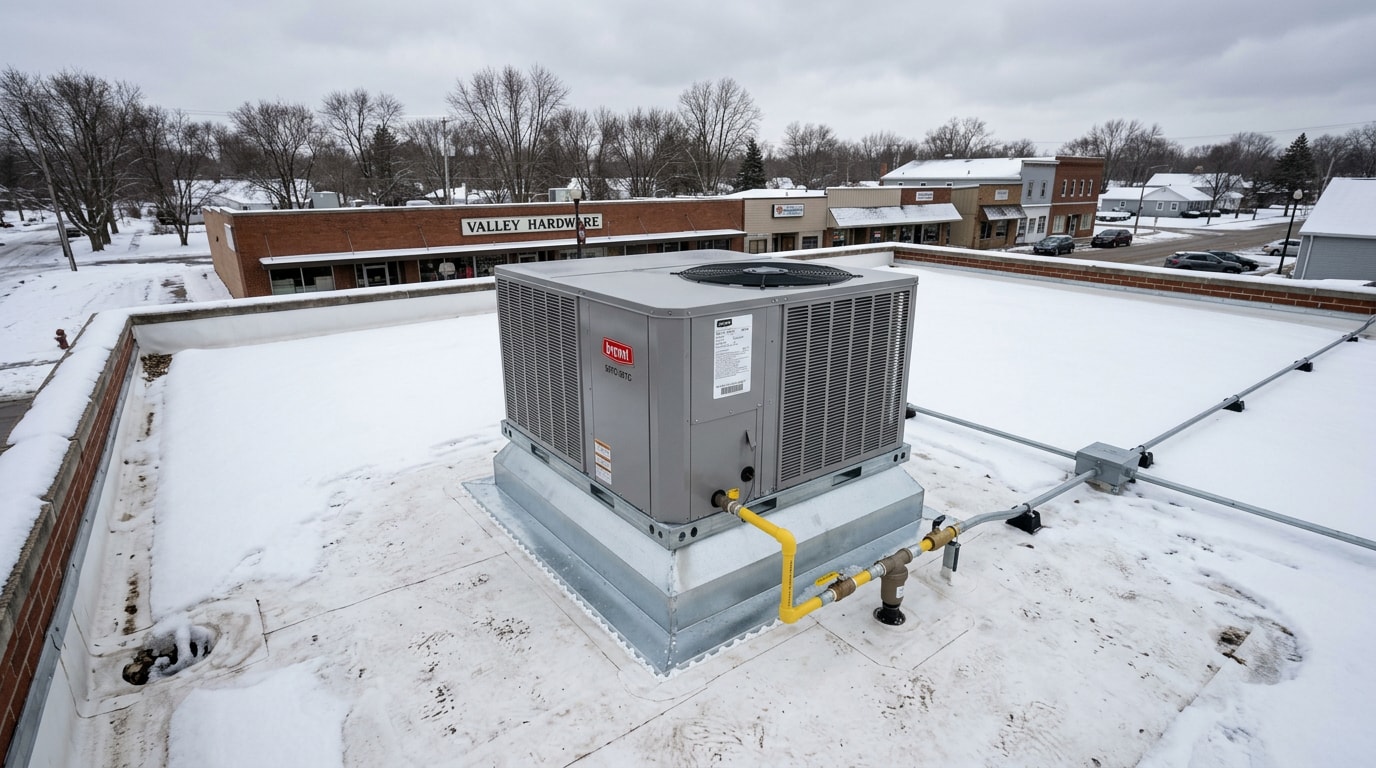
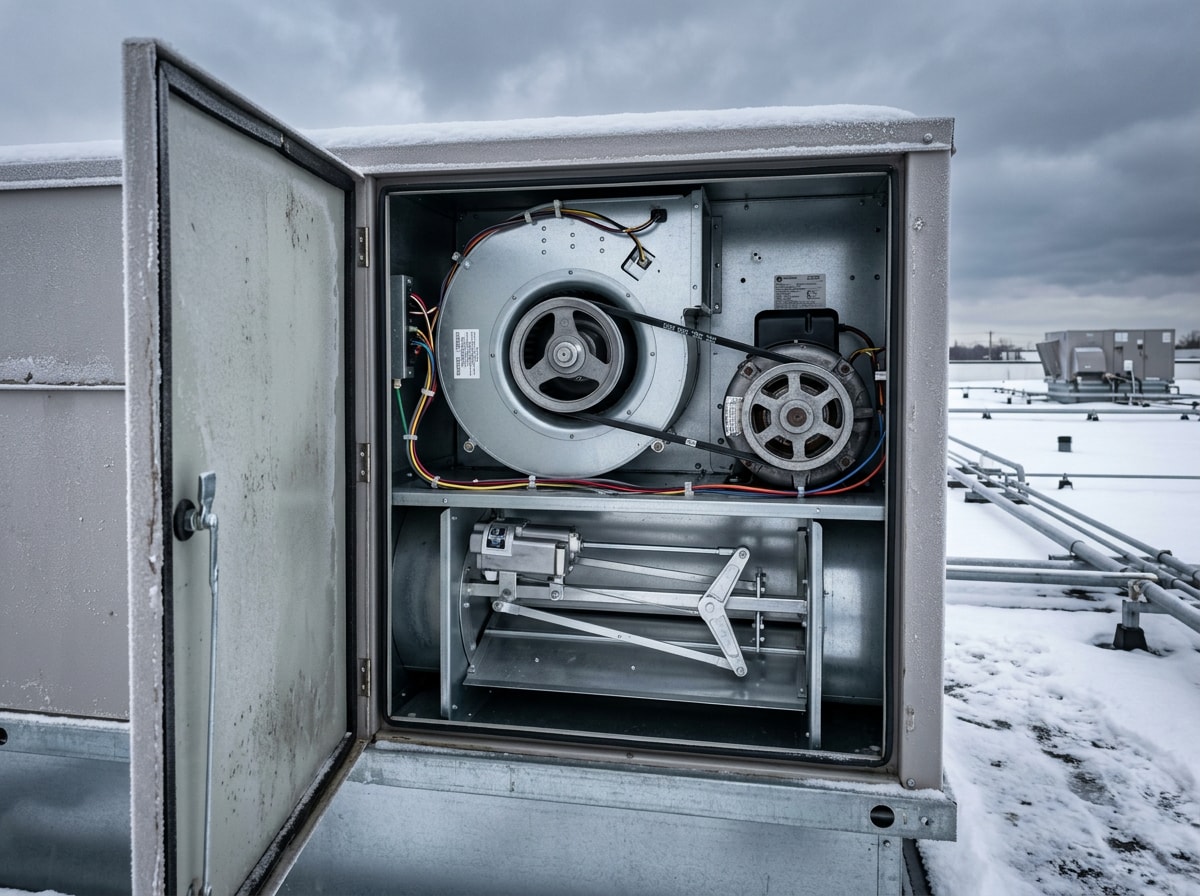
One pattern we see every January in Cadott: a rooftop unit that "won't heat" is frequently an economizer damper stuck partly open, pulling subzero outside air across the heat section while the unit runs itself ragged trying to hit setpoint. It reads like a failed furnace on the service ticket and costs a fraction of one to fix.
Get a free estimate or call before the next cold snap, not during it.
What to Verify Before You Hire a Commercial HVAC Contractor
Commercial work in Wisconsin is not residential work with a bigger unit. Verify these five items before booking.
- HVAC contractor registration and a qualifier credential. Installing or servicing HVAC equipment in Wisconsin requires contractor registration under the state trades program.
- EPA Section 608 certification for any technician touching refrigerant. It is federal law, not a nicety.
- Commercial plan review awareness.
If new HVAC equipment serves a commercial building, an addition, or an alteration, and the equipment is used in any way for ventilation or human comfort, HVAC plans may need to be submitted for plan review and approval, with the need for submittal depending on the volume of the building rather than just the size of the alteration. A contractor who has never heard of this is the wrong contractor.
- Current code knowledge.
Wisconsin's Commercial Building Code adopted the 2021 ICC as of September 1, 2025, and plans submitted on November 1, 2025 or later must comply with the updated code. Review the rules yourself on the Wisconsin DSPS commercial buildings and HVAC page.
- Proof of insurance naming your building. Ask for the certificate before the crew sets foot on the roof.
For buildings 50,000 cubic feet in total volume or greater, plans must be prepared, signed, sealed, and dated by a Wisconsin registered engineer or architect. That threshold catches a lot of Cadott warehouses, churches, and shop buildings that owners assume are "too small" to trigger anything.
See how we document this work on our project gallery.
Commercial Services for Cadott-Area Businesses
We cover the full life of the equipment: the 2 a.m. breakdown, the seasonal tune-up, and the replacement you have been budgeting for two years. Browse the full HVAC contractor service category or start on our homepage.
Commercial Repair
Commercial equipment fails differently than a home furnace.
Our techs handle rooftop unit repair: failed compressors, snapped belts, stuck economizers, plugged condensate drains, and controls that will not talk to the thermostat. We also cover air conditioning compressor repair, split systems, boiler repair, unit heaters, and make-up air.
Installation and Replacement
Every HVAC system installation starts with a load calculation, whether it is new construction, a planned swap, or an efficiency upgrade.
Sizing errors hurt in both directions. An undersized unit never catches up on a design day. An oversized one short-cycles, leaves humidity behind, and wears out early. We also handle air conditioning replacement on packaged and split equipment.
Preventative Maintenance
Wisconsin equipment works hard in both seasons. A spring and fall cadence catches wear before it becomes a failure.
A typical visit includes coil cleaning, belt and filter service, refrigerant and superheat checks, electrical tightening, and control verification. We run furnace maintenance and boiler system maintenance on contract schedules so the paperwork exists when a manufacturer asks for warranty documentation.
Buildings and Systems We Serve
Find your building: strip malls, retail and office suites, medical and dental offices, restaurants, churches, light manufacturing, ag-adjacent shops, and warehouses.
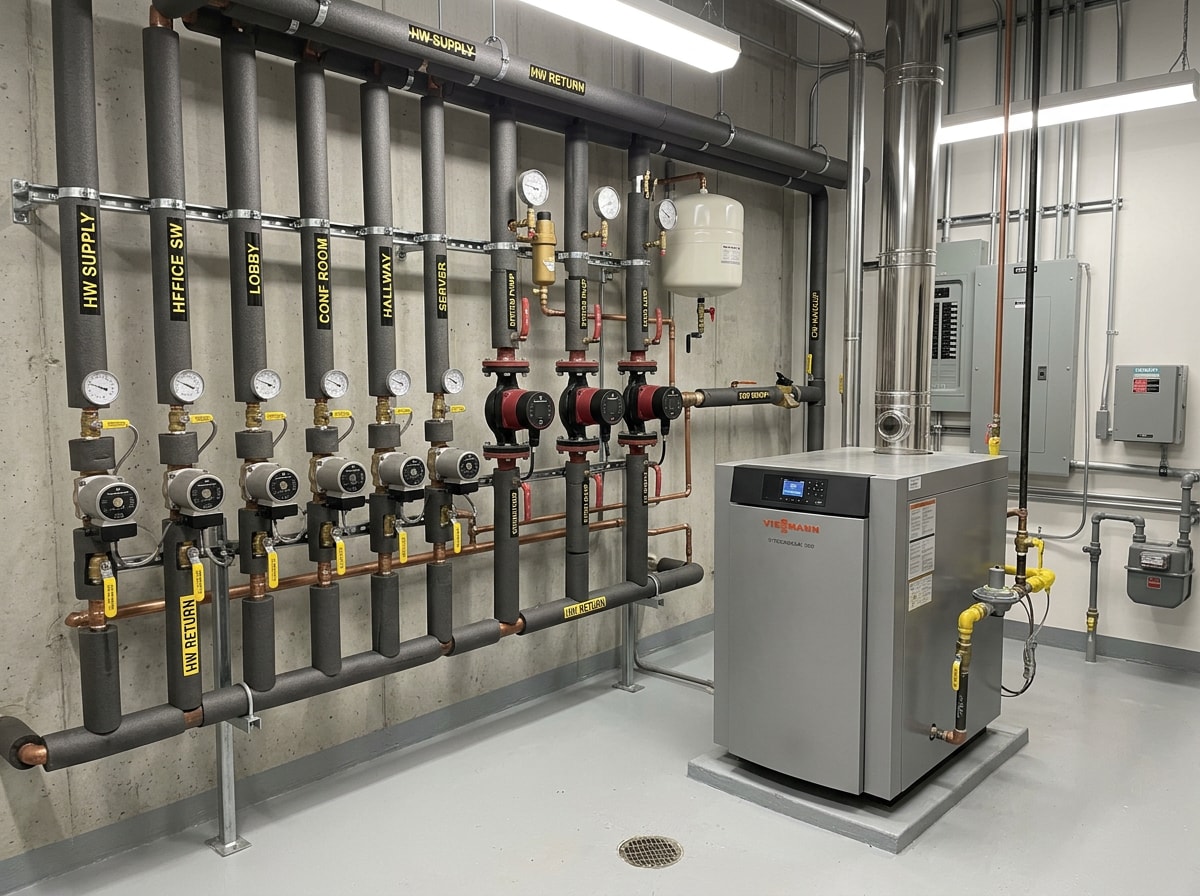
Matching systems include packaged rooftop units, split systems, heat pumps, hot water and steam boilers, unit heaters, and make-up air.
We serve Cadott plus Boyd, Stanley, Thorp, and the rest of Chippewa County.
How Much Does Commercial HVAC Cost in 2026?
A per-square-foot rule of thumb is a weak estimate. It ignores zoning, ductwork condition, electrical capacity, gas piping, and roof access, and those four items routinely move a bid more than tonnage does.
Real numbers come from a site walkthrough and a load calculation. Insist on an itemized quote covering equipment, labor, materials, ductwork, controls, crane time, disposal, and permits so bids compare honestly. Our breakdown of what an HVAC quote must include works the same way for commercial buildings.
| Scenario | Main cost drivers | Expect to be asked about |
|---|---|---|
| ~3,000 sq ft storefront, single packaged RTU | Tonnage, crane access, curb adaptation | Roof age, existing curb size, available power |
| ~10,000 sq ft office, multiple zones | Zone count, controls, ductwork rework | Occupancy patterns, window area, IT room loads |
| Warehouse with unit heaters and make-up air | Ceiling height, ventilation code, gas piping | Dock door usage, process exhaust, insulation |
| Boiler or hydronic replacement | Venting, near-boiler piping, controls | Fuel type, existing loop condition, zone valves |
Two local realities worth budgeting for. Our heating-dominated climate pushes equipment selection toward heating capacity, so the winter side of the unit usually sets the price. And rooftop lead times stretch in late fall, which is exactly when everyone discovers their heat section is cracked.
The rebate step most owners skip
Before signing, check incentives. Focus on Energy offers a range of incentives and services for Wisconsin businesses, each managed through its network of program specialists and Trade Allies. Prescriptive and custom incentives apply to commercial HVAC measures, and larger projects are generally expected to be submitted for approval before the equipment is installed, not after. Start at the Focus on Energy business incentives page and confirm eligibility while the bid is still a bid. A signed proposal that ignores this can quietly cost you thousands.
What Is the Life Expectancy of a Commercial HVAC Unit?
Published service-life data beats guesswork. ASHRAE's publicly available database contains service life data for major pieces of HVAC equipment , and the widely cited medians are blunt:
| Equipment | Median service life (years) |
|---|---|
| Rooftop air conditioner, single-zone or multi-zone | 15 |
| Commercial air-to-air heat pump | 15 |
| Gas or oil-fired furnace | 18 |
| Steel fire-tube boiler | 25 |
| Cast iron boiler | 35 |
| Gas or electric unit heater | 13 |
Those figures come from ASHRAE's equipment median-life data covering rooftop units, heat pumps, boilers, furnaces, and unit heaters. Check current figures in the ASHRAE service life database.
Read the word "median" carefully. Half the population lasted longer, half did not, and your unit's run hours, install quality, maintenance history, and roof exposure decide which half it lands in.
A neglected rooftop on a 24-hour restaurant will not reach the same age as a maintained office unit. That 15-year median is also why budgeting should start at year 12, not the morning the compressor grounds out.
Design/Build and Plan-and-Spec Projects
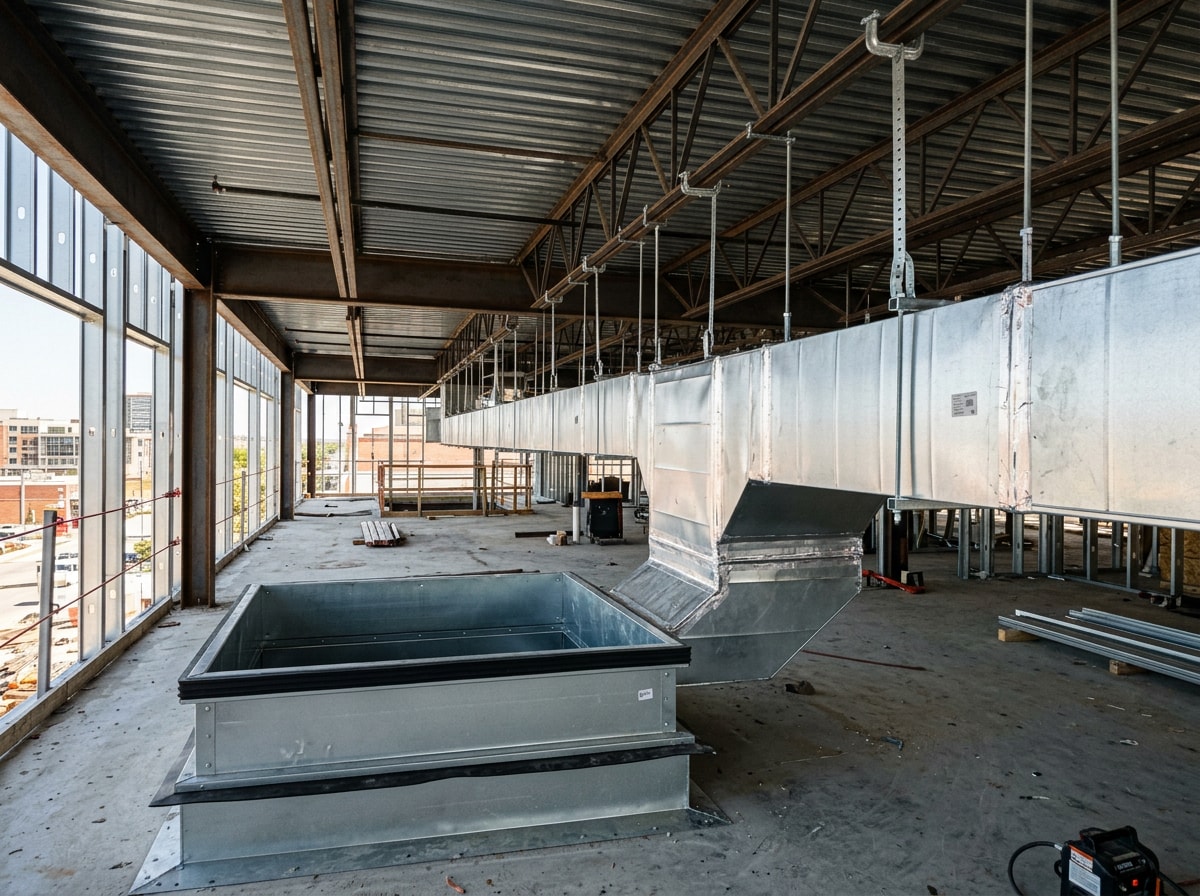
With design/build, we own the project from concept through startup instead of executing someone else's drawings. Project managers survey the site first, then size heating, cooling, and ventilation to the actual load.
Arriving with finished drawings from an architect or mechanical engineer? We bid plan-and-spec work too. We price the scope exactly as specified, flag constructability issues early, and coordinate rough-in with your general contractor so the trades behind us are not stalled.
Either way, DSPS does not issue commercial building permits, so the local municipality handles that, and a local permit is conditional on an approved plan review. Build that sequence into your schedule.
Work With a Local Commercial Team
We are a licensed and insured commercial HVAC company serving Cadott and the Chippewa Valley, servicing all makes and models including equipment we did not install.
If you manage a building here, the cheapest move available to you this quarter is a documented fall inspection with the readings written down. Static pressure, temperature rise, and amp draw recorded twice a year turn "it just quit" into a repair you scheduled on your own calendar.
Request your free estimate and we will walk the roof with you.
FAQ
How often should commercial HVAC be serviced?
Twice a year minimum: spring before cooling season, fall before heating season. Restaurants, medical and childcare facilities, high-traffic retail, older equipment, and buildings running extended hours usually need quarterly visits.
Do you service all makes and models?
Yes. We provide brand-agnostic service on all makes and models, including systems installed by another contractor. Send us the nameplate data and we will source parts and support it.
What size commercial HVAC system does my building need?
Sizing comes from a load calculation, not square footage. Inputs include envelope and insulation, occupancy, window area, ceiling height, orientation, ventilation requirements, and equipment heat gain. Oversized systems short-cycle, leave humidity behind, and fail early.
Should I repair or replace my commercial HVAC system?
Weigh age against published service life. If repair costs approach a third of replacement, breakdowns repeat within a season, or parts are obsolete, replacement usually wins. A 15-year-old rooftop needing a compressor is rarely worth the repair.
Do I need a permit to replace a rooftop unit in Wisconsin?
Usually yes, through the local municipality, and plan review may apply depending on building volume and whether ductwork or controls change. If your municipality has delegated authority for plan review at that project size, you may be able to submit locally; otherwise plans go to DSPS through its electronic system. Confirm before ordering equipment.
What is the difference between commercial and residential HVAC service?
Equipment type, code path, and access. Commercial work involves packaged rooftop units, economizers, building controls, three-phase power, ventilation requirements, and plan review obligations that residential jobs never trigger.
How fast can you get to a Cadott building after hours?
We dispatch 24 hours a day across Cadott, Boyd, Stanley, Thorp, and the surrounding county. Travel time is the main variable, and we give you an arrival window when you call rather than after the truck arrives.
Can you take over a maintenance contract from another contractor?
Yes. We inventory the equipment, record baseline readings, and pick up the schedule. Bring your last two service reports if you have them so we know what was already replaced.
For heating, cooling, boiler, and hydronic questions across the Chippewa Valley, our commercial service team is reachable through the contact page. We are a licensed and insured Wisconsin HVAC contractor, and every recommendation above reflects work performed on Chippewa County commercial buildings.